
Who’s Missing? What A Post-COVID Jury Might Look Like
May 11, 2021
In Part One of this two-part series, DRC reported on its March 2021 survey that found, more than a year after the start of the Coronavirus pandemic in the United States, some jurors remain extremely anxious about jury duty.[1] The pandemic has highlighted social and racial injustice and inequity in public health, as COVID-19 has unequally affected Black, Indigenous, Hispanic / Latinx, and other people of color. Nationwide, Black Americans have died from COVID-19 at 1.9x the rate of White Americans; Hispanic / Latinx Americans at 2.3x the rate; and American Indian or Alaska Native persons at 2.4x the rate.[2]
This unequal way in which COVID impacts different communities is reflected in the results of DRC’s survey, as a relationship was observed between: (i) demographic characteristics, (ii) the belief that it is not safe to hold jury trials, and (iii) reluctance to show up for jury duty. Respondents were asked if they felt it was safe to hold jury trials at this time. The results show that racial and ethnic minorities were more likely than White respondents to believe that it is not safe to hold jury trials at this time. The study showed that women were also more concerned about the safety of jury duty than men were.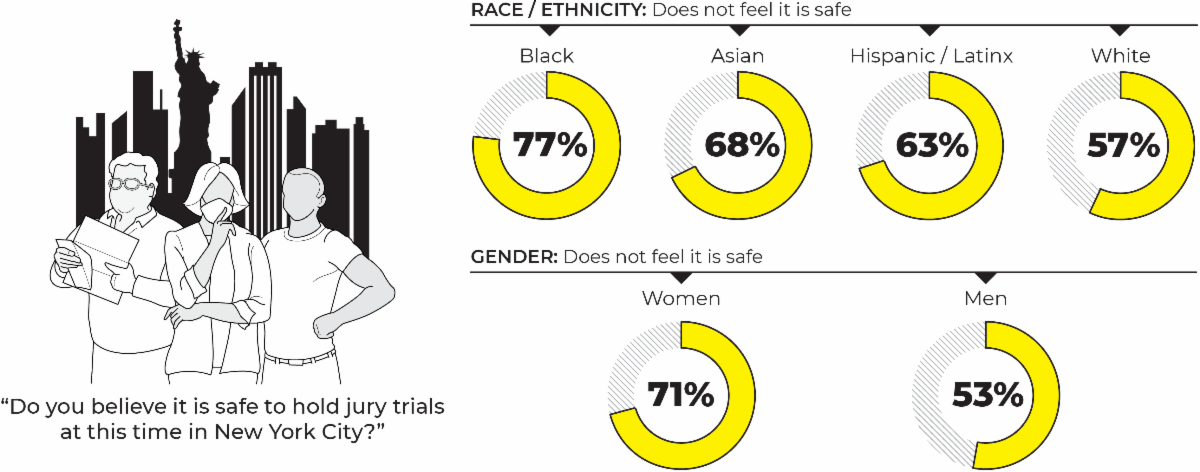
Racial and ethnic minorities and women expressed greater concerns for their health and safety and more uneasiness about serving as a juror than their White male counterparts. When asked to rate the extent to which they agreed or disagreed with the statement “If I received a jury duty summons today, I would be concerned about my health while serving as a juror,” 75% of all respondents either somewhat or strongly agreed. DRC observed a statistically significant relationship based on race and ethnicity such that Black respondents (47%) were more inclined to strongly agree with this statement than White respondents (38%). Women (47%) were also more likely to strongly agree with the statement than men (32%).
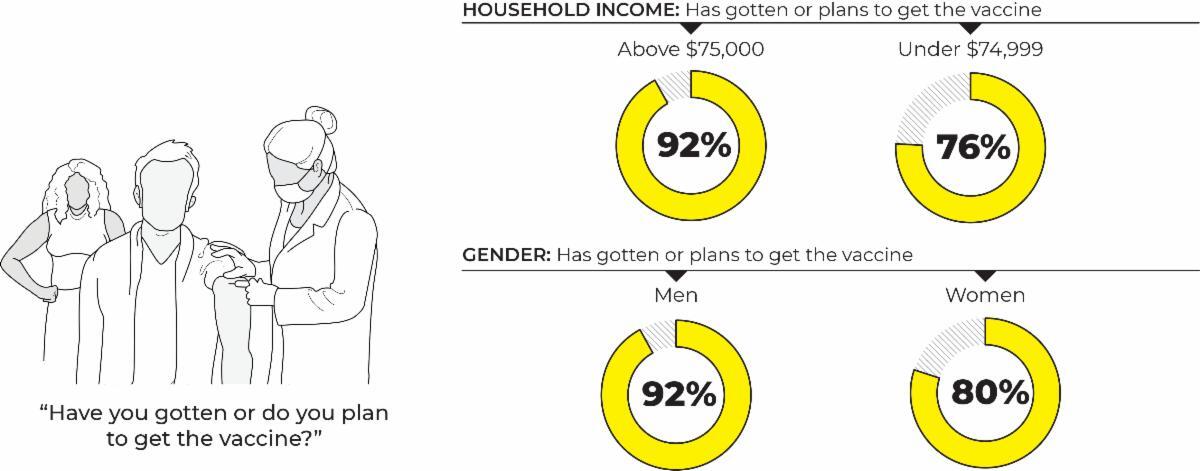
Similar to DRC’s study, a June 2020 National Center for State Courts survey found that both younger and older Black and Hispanic / Latinx women were more hesitant to appear for jury duty as compared to younger, non-college-educated, politically conservative White males [3]. However, despite reporting higher fears of contracting the virus and more health concerns related to serving on a jury due to the virus, DRC observed that racial and ethnic minorities were more hesitant to get the vaccine than White respondents.

This correlates with CDC data on vaccinations by race and ethnicity. White people make up 74% of vaccinations, while only comprising 63% of the U.S. population. Black people make up 11% of vaccinations while making up 16% of the total population, and Hispanic / Latinx people make up 15% of vaccinations while accounting for 19% of the total population.[4]
DRC also found that respondents with lower household incomes also reported more reluctance in getting the vaccine, and women reported less willingness to take the vaccine than men.
The overall COVID-related health concerns and reluctance to get the vaccine unsurprisingly leads to greater hesitation from a diverse group of potential jurors to serve jury duty. As explored in the first part of this series, courts have seen widespread unwillingness from jurors to appear at court when summoned. For example, of the forty jurors U.S. District Connecticut Judge Kari A. Dooley called on May 4, 2021, for a federal trial, only 12 appeared, and of those, one was excused.[5] Similarly, last month in Muscogee County, Georgia, less than 20% of those summoned to jury duty reported.[6]Courts have already expressed concerns that the few prospective jurors who will show up for jury duty may not constitute a representative cross-section of the venire. U.S. District Judge James E. Boasberg of the District of Columbia acknowledged “that any pandemic jury may not represent a fair cross-section of the community, given the potential for diminished representation from various sub-groups, including those vulnerable to or living with others vulnerable to severe complications from COVID-19, as well as caregivers whose children are not in school.”[7]
It is concerning that a smaller pool of self-selecting jurors are willing to sit on a jury in a post-pandemic world, especially when the data demonstrates the population most comfortable with appearing for jury duty is ethnically and politically homogeneous. Considering that racial and ethnic minorities, women, and lower-income jurors report both higher fears of the virus and higher reluctance in getting the vaccine, there is good reason to believe prospective jurors who do respond to their jury summons and show up to court will not make up a representative cross-section of the venire. Therefore, attorneys must be aware that the summoned jurors who arrive for jury duty may not be demographically reflective of the community, should make an appropriate record, and take extra steps to include a diversity of opinions to ensure a fair and impartial jury trial for their clients.