
Two Demonstratives to Incorporate into Your Next Case
January 25, 2019
In today's media-savvy society, it is more critical than ever for attorneys to use persuasive demonstrative aids. Demonstrative aids are the best way to efficiently educate jurors about important or complex issues. Social psychological research suggests that the presentation of visual stimuli during a trial improves an attorney's ability to persuade the jury and improves juror retention of key facts and arguments.
In today's media-savvy society, it is more critical than ever for attorneys to use persuasive demonstrative aids. Demonstrative aids are the best way to efficiently educate jurors about important or complex issues.
Social psychological research suggests that the presentation of visual stimuli during a trial improves an attorney's ability to persuade the jury and improves juror retention of key facts and arguments.
For example, a study conducted by social psychologist, Jaihyun Park, and law professor, Neal Feigenson, looked at the effect visual technology had on juror decision-making.' The study compared opening statements delivered with and without PowerPoint presentations and found that mock jurors were persuaded more often when visuals were used. The study found that the use of visual aids correlated not only with level of juror persuasion, but also with recollection of evidence and perceptions of the advocates.
Park and Feigenson discovered that the percentage of jurors who found the defendant guilty was highest when the prosecution used visual aids but the defendant did not. When the defendant used visuals and the prosecution did not, the percentage of jurors that found the defendant guilty dropped significantly.
The study also found that use of demonstratives increased accuracy and memory when jurors were asked to recall specific statistical evidence relating to the defendant. Finally, Park and Feigenson found that when the defense attorney used visual aids, jurors perceived the attorney as better prepared, more competent, and more credible. As exemplified by this study, an attorney's use of visual aids provides an advantage.
Consistent with these findings, at DRC's focus groups we find that mock jurors are able to recall specific arguments more accurately and completely when the argument is reinforced by a specific demonstrative aid during the presentation. Jurors not only learn concepts or facts in a case through the use of visuals, but often employ recollection of a specific demonstrative to support their position and convince other jurors why they view a particular issue a certain way. During post-deliberation facilitation, jurors frequently express that certain demonstratives decided the case for them.
Timelines
Post-trial interviews of jurors from both focus group exercises and actual trials indicates that jurors are often confused about the timing of key events. Given the many dates, documents, and parties often involved in a given case, many jurors find themselves temporally adrift in the evidence. Therefore, it is important at trial to ensure that jurors fully appreciate the chronology of the evidence and arguments. This is best achieved by presenting an overarching timeline populated with a handful of significant events during your opening or closing statement. Those key events are temporal anchors for jurors to use as reference points for other important events. As such, timelines become crucial tools on which jurors rely on during deliberations. Below is an example of an effective timeline: 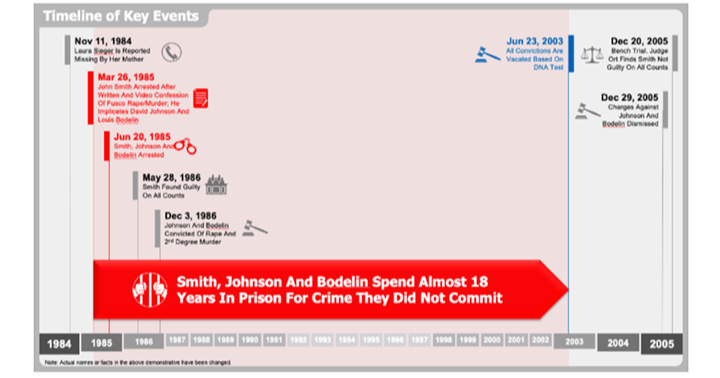 Comparative Reasoning Charts
Another effective demonstrative aid frequently used by our clients is a comparative reasoning chart. Comparative reasoning is the practice of comparing one argument against another.
This form of logical reasoning helps jurors decide which of two competing inferences is best supported by the evidence. The psychology of decision-making has been widely studied and the overarching research indicates that because humans struggle to evaluate arguments on a standalone basis, comparisons allow jurors to establish a benchmark in their decision-making process to evaluate what is true or untrue, or what is better or worse.? In other words, comparative reasoning appeals to the human decision making process because it allows jurors to have a standard to analyze arguments against, so they do not have to evaluate statements in a vacuum. Put simply, the presentation of an alternate argument or benchmark allows jurors to more easily draw conclusions and to experience a greater comfort with decision making. An example of a comparative reasoning demonstrative is below: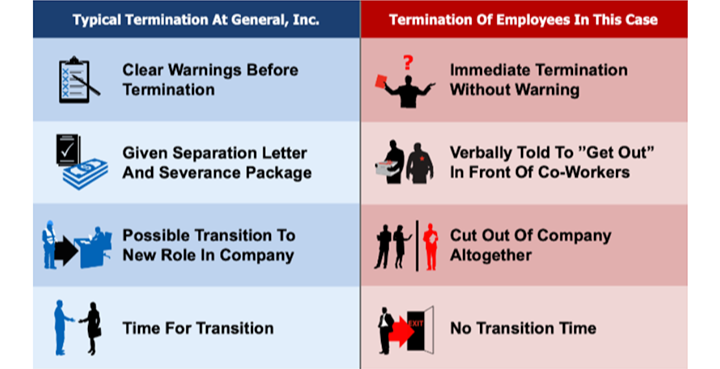
Persuasive demonstrative aids are no longer a luxury item reserved for "big cases." They are a "must-have" tool for today's media-savvy and media-saturated juries. The effective use of persuasive demonstrative aids, like the ones presented above, will maximize your trial presentation and put you in the best position to win.
* The actual names and facts in these demonstratives have been changed.